From Prisons to Community Studios: Fellows’ Blogs from 2025
Across 2025, Fellows wrote blogs sharing learning that ranged widely across issues and sectors – from studying food culture inside prisons to mapping how ethical storytelling strengthens belonging.

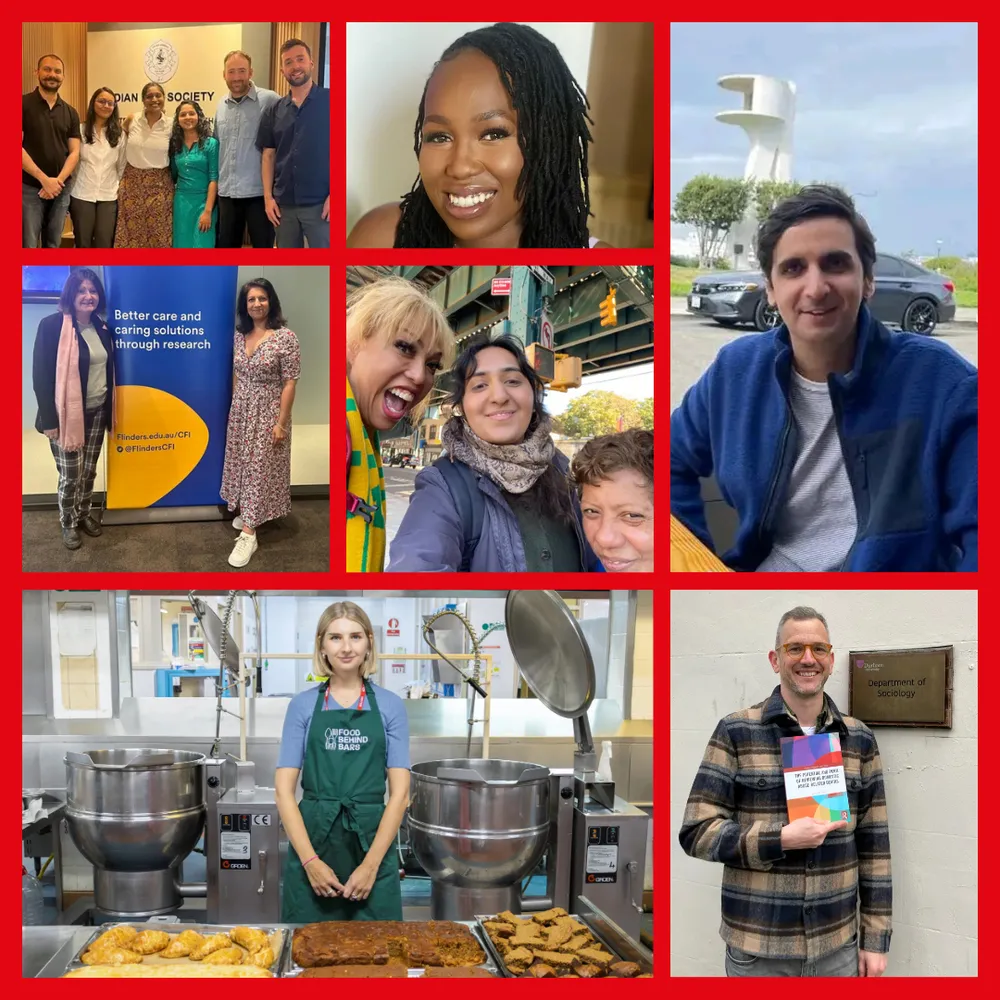
These blogs took us into prisons, care homes, community studios, rural town halls, and laboratories, showing not only what they learned overseas but how they continued to exchange ideas, build networks, and deepen connections long after returning. Taken together, they show Fellows thinking ambitiously about justice, care, culture, innovation, and connection – and offering practical insights that are already influencing practice in the UK.
Domestic abuse was a recurring focus. Judith Vickress brought forward the realities of rural victim-survivors – from slow responses to inconsistent police engagement – and showed why designing effective interventions starts with listening. Meanwhile, James Rowlands examined the system itself, reflecting on how fatality reviews in Australia, Aotearoa New Zealand, Canada, and the USA could help prevent domestic abuse-related deaths in the UK.
Prisons and criminal justice were another significant area of exploration, with Fellows examining the system not just in terms of process, but through the experiences of the people living and working inside it. Piers Barber looked closely at postvention in custody, drawing on examples from New Zealand, Australia, and Canada to show how chaplains, trauma training, and consistent aftercare can save lives. Lucy Vincent explored food culture and dignity in prisons, connecting lessons from Scandinavian catering to her mission to support UK prison catering teams.
Suicide prevention also featured strongly, approached from different angles but connected by a shared urgency. Rory Keddie considered how medical students can be better prepared to support people in crisis, building on models from India, the USA, and Canada and his work training thousands of UK students. Five years on from her Fellowship, Sangeeta Mahajan reflected on gaps in bereavement support and her ongoing work to strengthen education and peer-led networks. And Anoo Bhalay wrote about the absence of language around suicide in her own community, and how learning in India and Canada helped her start conversations that previously felt unreachable.
Health and wellbeing learnings appeared in varied ways across the year. Shaun Qureshi examined how palliative care can reconnect with its radical origins by addressing the inequities faced by marginalised groups, drawing on insights from services in the USA and Canada. Monica Lakhanpaul explored the experiences of children living in temporary accommodation and argued for solutions that place their voices at the centre. Meanwhile, Sue Sharples wrote about sexual self-advocacy for adults with learning disabilities, rooted in the belief that people “should be their own first line of defence”.
Innovation and technology also emerged as an important thread this year, with Fellows examining how digital, scientific, and sensory tools can offer care. Jenny Tillotson charted how scent-based wearable tech is being developed to support mental wellbeing, while Emma Tilley explored how Investigative Genetic Genealogy could be used ethically in UK policing. Laura Wyatt-Smith examined how the digitalisation of childhood is shaping family life, drawing lessons from tech hubs in the USA and Europe.
Learnings from arts and culture highlighted how creativity can deepen place, belonging, and inclusion. Dominic Heslop explored the “cultural architecture” that allows creativity to take root in communities, applying learning from Jamaica, Berlin, and Athens to his work with young people in Sheffield. Saira Niazi’s journey through 41 neighbourhoods across the USA helped her understand how storytelling can be more inclusive and community-led, leading to the Renegade Guides Handbook. Faith Yiminyi reflected on how a Fellowship at age 21 shaped a diverse career, while Cas Holmes looked back on a Fellowship taken four decades ago that still informs her creative practice.
In addition to Faith and Cas, this year brought further reflections from Fellows whose journeys stretch back decades. As part of marking our 60th anniversary, we reached out to earlier generations of Fellows to understand the long-term influence of their travels. Elizabeth Carrington revisited her 1973 Fellowship on physiotherapy for children with neurological conditions, tracing how it shaped a global career, while Robert Reeves reflected on introducing Wellness programmes to the UK after learning from pioneers in the USA.
At the other end of that timeline, Tim Woodhouse – who completed his Fellowship only recently – offered a look at the immediate impact that can follow a Fellowship. His work on domestic abuse-related suicides has already led to more than 100 talks, national media engagement, and the beginnings of a PhD. As he put it, “the years after you return home is actually where the power of the Churchill Fellowship can kick in.”
Looking back at 2025, Fellows showed how global learning continues to spark new thinking, deepen understanding, and inspire change across the UK.
Discover more reflections on our Blogs and Conversations page.
Disclaimer
The views and opinions expressed by any Fellow are those of the Fellow and not of the Churchill Fellowship or its partners, which have no responsibility or liability for any part of them.