In conversation with Melvin Hartley: Harnessing the power of spontaneous volunteers - The Churchill Fellowship

In conversation with Melvin Hartley: Harnessing the power of spontaneous volunteers

The goal of any Churchill Fellow is not only to learn more about their chosen area of interest, but to put what they learn into practice. For 2019 Fellow Melvin Hartley, circumstances created an immediate opportunity for him to do so – less than a month after returning from his travels, he began actioning his findings in response to the Covid pandemic.

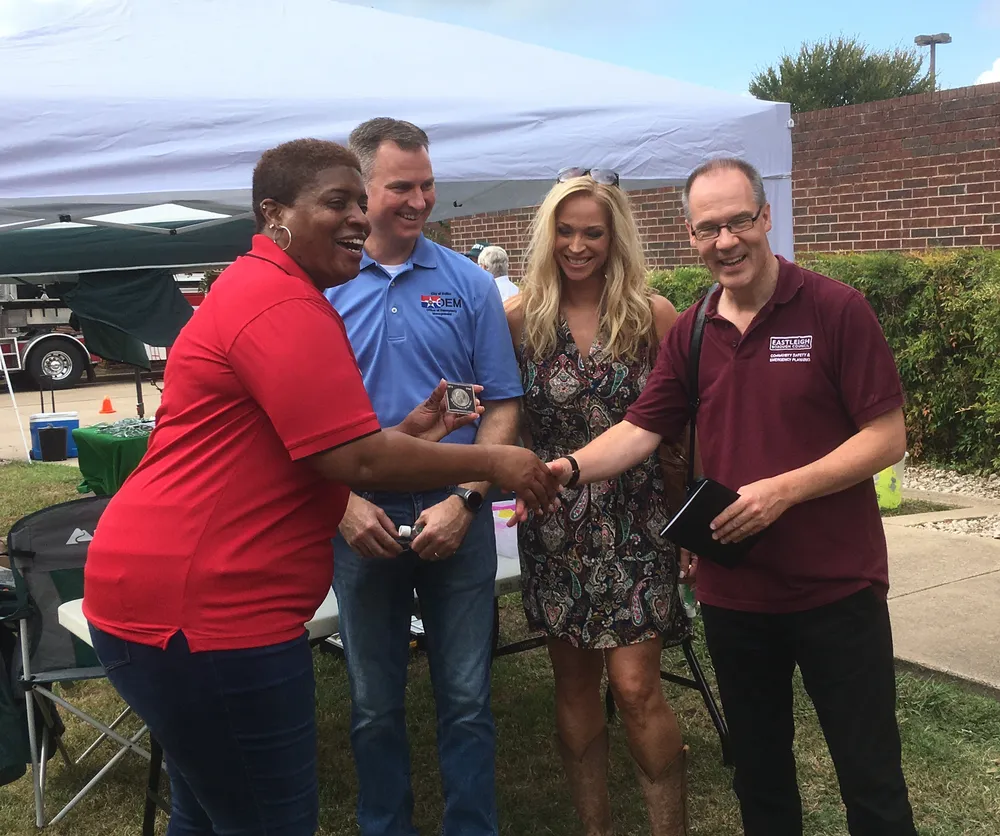
Melvin presenting a Churchill Crown to Cassandra from the Dallas City Emergency Management Service as a thank you for hosting him. She works closely with the volunteers of the Dallas CERT (Community Emergency Response Team). Download 'Melvin Hartley blog'

An emergency planning expert based in Hampshire, Melvin was uniquely placed to use his learning to harness the power of ‘spontaneous volunteering’ during the March 2020 lockdown and the months that followed.

But what inspired Melvin’s Fellowship in the first place?

“I was already interested in the role of volunteering in the wake of disasters, but the real catalyst was what happened after the Grenfell Tower fire. This showed that much of what needed to be done was dealt with by spontaneous volunteers who came from all over the country, and indeed from abroad.”

Melvin wanted to explore ‘spontaneous volunteers’ further, and discover how this support after a disaster could be used most effectively. As he says, “Volunteers are a resource you ignore at your peril.”

How volunteers are organised in America

Melvin spent five weeks in the USA, which has adopted a nationwide Volunteer Reception Centre model. Used alongside advanced planning for major events such as hurricanes, it gives direction to spontaneous volunteers so their support can be used effectively.

Melvin’s travels took him across America, including witnessing the path of a major hurricane and observing first-hand how the Volunteer Reception Centre model was put into practice.

He was particularly interested to learn that, in America, the national Community Emergency Response Teams (CERT) programme has an offshoot for teenagers, often based in schools. Could he mirror this model in the UK?

Spontaneous volunteering and the pandemic

Melvin returned to the UK on 9 March 2020 – the eve of the Covid pandemic – and almost immediately began to put his learning into practice.

“I had over 1,500 volunteers working with me in Eastleigh, doing everything from shopping for those who were shielding to collecting pharmacy prescriptions, to delivering support services, and this ran across the borough for 18 months.”

Similar initiatives sprang up across the country, and now most of the UK’s Local Resilience Forums, which manage emergency planning, direct and integrate volunteering from unaffiliated individuals as part of their planning and response to events.

"I would never have got to this stage without the Fellowship; it has been transformational because it gave me time and has opened doors."

Harnessing the input of older teenagers

The idea of tapping into older teenagers’ abilities, via formal youth organisations such as the Scouts, was one Melvin wanted to explore further. It ultimately led to the creation of HYPER – Hampshire Young People’s Emergency Response.

“This was an idea we had before I went to America. Our official launch was planned for 2020, but we eventually launched in June 2022. After the launch, it was a matter of waiting to see if anything would happen – and it did!”

The week before Christmas 2022, the local water company had a massive outage affecting 25,000 houses.

“We called the Scouts and Police Cadets to help run the water stations and they were amazing! They worked for two full days and the praise from the public was fantastic.”

The young people leapt into action again two months later when there was a second water outage, this time affecting 56,000 homes.

“We proved the concept that young people can be used in response, not just preparation, under the leadership of their uniformed youth organisations.”

Taking the HYPER concept national

Melvin is keen to promote HYPER and regularly speaks at events. He works closely with the National Consortium for Societal Resilience and, in October, will speak at the Somerset Prepared Community Resilience Day.

Already, there is interest from other areas, including Cumbria, in setting up their own version of HYPER.

And Melvin’s work continues. He is now researching how young people’s volunteering support is already being engaged.

“I would never have got to this stage without the Fellowship; it has been transformational because it gave me time and has opened doors. If it doesn’t sound too grand, I would like the legacy of the Fellowship to be that people recognise that older teenagers, although they are still young, are really as capable as any adult.”

Disclaimer

The views and opinions expressed by any Fellow are those of the Fellow and not of the Churchill Fellowship or its partners, which have no responsibility or liability for any part of them.

Related

Blogs & conversations

Counting women, ending homelessness

Sarah Walters reflects on how her Churchill Fellowship learning from the USA and Canada continues to shape her work to end women’s homelessness in the UK. Her visits showed the power of gender-informed, trauma-aware services designed around women’s experiences, from specialist housing to support that helps women rebuild their lives. She shares how this learning informed a women-only respite hotel as part of Crisis at Christmas 2025, and how it continues to inspire change in services for women experiencing homelessness.

By Sarah Walters,

Blogs & conversations

Following curiosity towards lasting change

Following her Fellowship across Australia, New Zealand, and Canada, Clare Holdsworth reflects on how paid lived-experience roles can support care-experienced young people to shape services, policy, and practice. Drawing on conversations with organisations, professionals, and young people, she explores what it takes to make these roles psychologically safe, meaningful, and supportive of long-term careers. She is now sharing this learning in Sheffield, using curiosity as a way to ask better questions with young people, not just about them.

By Clare Holdsworth,

Blogs & conversations

The shared legacy supporting kinship carers

We spoke to Lucy Peake, Churchill Fellow and CEO of Kinship, about how her Fellowship is shaping support for kinship carers in the UK. Travelling to the USA, she explored kinship navigator programmes and found strong parallels with Kinship Connected, the support model developed by her organisation. Her learning is now informing new trials and partnerships, with the aim of building stronger evidence and securing long-term investment in kinship care – helping to shape a more consistent, better-supported system for kinship families.

By Lucy Peake,

Blogs & conversations

Building together: rethinking teacher wellbeing and career sustainability

During her Churchill Fellowship in Ghana, Dr Chiedza Ikpeh explored how teacher wellbeing grows through community, adaptability, and shared responsibility. Speaking with teachers, she how collective approaches help educators thrive, even in challenging conditions. Witnessing this resilience reshaped how she understands teaching and what allows careers to be sustained over time, and Chiedza is now bringing this learning into her research and development work with teachers across the UK.

By Chiedza Ikpeh,

Newsletter Sign Up